
In short
Choosing the wrong part of Valencia can cost you more than rent: forty minutes of extra travel a day, night-time noise you never expected, or a beach postcode that feels isolated in winter. Valencia is compact, but cross a major avenue, a park or a set of railway tracks and the rhythm changes completely.
There is no single best neighbourhood for everyone. A remote worker who wants cafés needs something different from a family looking for schools and parks, and someone without a car cares more about Metrovalencia and EMT connections than an extra bedroom. This ranking doesn’t quote fixed rents: asking prices move quickly, streets differ, and a renovated flat with a lift and air conditioning is a different product from an older walk-up.
The ranking, from No. 7 to No. 1
-
Ciutat Vella
The old city: stone lanes, plazas, the Central Market and landmarks on foot. Irresistible for a month’s stay, harder for everyday life. Parts of El Carme stay lively late, older buildings may lack insulation, a lift or light, and tourist activity can be exhausting in high season. If you’re tempted, visit a flat three times: morning, dinner time and after midnight on a Friday.
Watch this part · 2:00 -
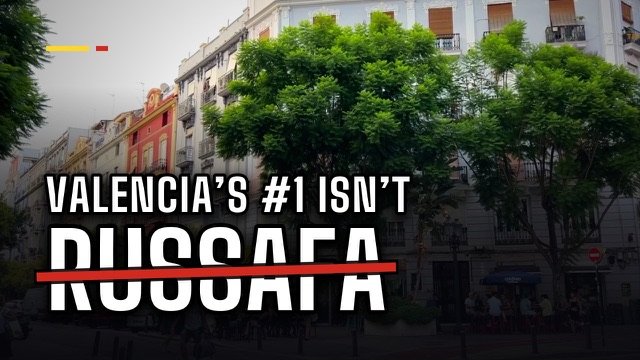
Russafa
The neighbourhood most newcomers already know: independent restaurants, coffee shops, markets and a social life that starts outside your building. Good for meeting people and an easy first landing. The compromise is popularity: demand pushes asking rents above less fashionable districts, restaurant streets get noisy, and a flat over a busy terrace is a very different experience from one on a quiet side street.
Watch this part · 3:12 -
El Cabanyal and the maritime districts
Tiled houses, local bars, the Cabanyal market, tram connections and the beach without a resort town. Superb for swimmers, runners and dog owners. The trade-off is distance and unevenness: some streets are beautifully restored, others still rough, and buildings vary greatly. Watch the map too: Patacona is often advertised as Valencia beach living, but it is in neighbouring Alboraya, with different municipal services.
Watch this part · 4:30 -
Campanar
An older village core with newer apartment developments, shopping, schools, healthcare and Turia access. Families value the larger modern buildings, lifts, garages and communal spaces that are hard to find in the historic core. The weakness is variation: the newer zones near shopping and main roads feel very different from traditional Campanar, so walk the route to your actual needs.
Watch this part · 5:52 -
Benimaclet
Feels like a small town the city grew around: a low-rise centre, local squares, cultural associations, students and long-term residents. Well connected by metro and tram, and lively without the Russafa premium. Nightlife and student energy are benefits only when you want them, and older properties differ sharply in ventilation, insulation and accessibility.
Watch this part · 7:04 -
Patraix
What people find once they stop searching only the obvious places. A historic heart, residential streets, local shops, Metrovalencia access and daily life that isn’t shaped by tourism. It can offer better relative value than the centre or Russafa, though no area should be assumed cheap now. It delivers no instant spectacle, but it supports routines.
Watch this part · 8:19 -
The Turia-side middle ground
Not a single label but a zone: well-connected parts of Extramurs, La Petxina and the edges of Arrancapins along the Turia gardens. Walk or cycle into the centre, use the old riverbed as a green route across the city, and avoid the tourist pressure of Ciutat Vella. There are compromises: noisy main avenues, some older buildings, prices that aren’t low, and “beside the Turia” can still mean a fifteen-minute walk to the part you want.
Watch this part · 9:34
Quick decision guide
| If you want… | Look at |
|---|---|
| Atmosphere and a short, immersive stay | Ciutat Vella |
| Restaurants, social energy and an easy landing among other newcomers | Russafa |
| The beach as a weekly habit, not an occasional photo | El Cabanyal |
| Modern residential comfort, family routines and road access | Campanar |
| Community, student energy and a neighbourhood with its own voice | Benimaclet |
| Grounded local life with a balance of connection and value | Patraix |
| The most flexible version of Valencia | The Turia-side middle ground |
Before you pay a deposit
- Verify the address, commute, building condition and noise.
- Check cooling, heating, the lift and internet options.
- Confirm the contract type (see the renting guide).
- Search the street, not just the neighbourhood.
- Visit at the hours you will actually live there.
Chapters
- 0:00Choosing wrong costs more than rent
- 0:49How the ranking works
- 2:00No. 7: Ciutat Vella
- 3:12No. 6: Russafa
- 4:30No. 5: El Cabanyal and the maritime districts
- 5:52No. 4: Campanar
- 7:04No. 3: Benimaclet
- 8:19No. 2: Patraix
- 9:34No. 1: the Turia-side middle ground
- 10:57The quick decision guide
- 12:19What’s next
Before you rely on it
All information accessed 26 July 2026. Confirm current listings, transport services and municipal rules before making a housing decision. Rankings are a judgement on everyday practicality, not a measurement.